1. Find the length of an arc in a circle of radius 10 centimeters subtended by the central angle of 50°

An arc length S is the length of the curve along the arc. Just as the full circumference of a circle always has a constant ratio to the radius, the arc length produced by any given angle also has a constant relation to the radius, regardless of the length of the radius. The radian measure is also depends only on the angle. A full revolution (360°) equals 2π radians. A half revolution (180°) is equivalent to π radians.



2. Graph  on [-4π, 4π] and verbalize how the graph varies from the graphs of
  .
.


A function that has the same general shape as a sine or cosine function is known as a sinusoidal function. One of the general forms of sinusoidal functions is y = Asin(Bx − C) + D, where A represents its Amplitude, B represents its Periods, C and D represents its shifts. In this case,  has only inconstant Amplitude X. Therefore, this function is expected to be a function that has the same period of
  but with larger and larger Amplitudes. And, since the function is repeating its values between the interval [-1, 1], when
  or
or  , the function
  will repeatedly has the value of X and -X. In fact, they are the intersections of these functions, ,
  , and
, and 
Graph 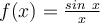 on the window [−5π, 5π] and describe freely what the graph shows.

Similar to the previous sinusoidal functions. One of the general forms of sinusoidal functions is y = Asin(Bx − C) + D, where A represents its Amplitude, B represents its Periods, C and D represents its shifts. This time,
 has only inconstant Amplitude
  . Therefore, this function is expected to be a function that has the same period of but with smaller and smaller Amplitudes. And, since the function is repeating its values between the interval [-1, 1], when
  or , the function
  will repeatedly has the value of 1/X and -1/X. In fact, they are the intersections of these functions, ,
  , and
, and

3. A 23-ft ladder leans against a building so that the angle between the ground and the ladder is 80°. How high does the ladder reach up the side of the building?
If the ladder is lean against the TOP of the building and the building is vertically standing above the ground, we can use the sine function to solve this question. That is the heigh of the building is

If the ladder is NOT lean against the TOP of the building and the building is vertically standing above the ground, then the height we just calculated is just a portion of the building and it represents where the ladder reach up the side of the building.

![(1+ \sqrt[]{3}i)^3](https://my.uopeople.edu/filter/tex/pix.php/e2a1aa6d30a021d4041e05b48fbfd819.png "(1+ \sqrt[]{3}i)^3")
![r= \sqrt[]{ 1^{2}+( \sqrt[]{3})^2 } =2](https://my.uopeople.edu/filter/tex/pix.php/27e227ed3f7354581e815bbd29ef736c.png "r= \sqrt[]{ 1^{2}+( \sqrt[]{3})^2 } =2")
![tan \theta= \sqrt[]{3}](https://my.uopeople.edu/filter/tex/pix.php/fbaaa49376a34eac20e70354b2af50f2.png "tan \theta= \sqrt[]{3}")

![(1+ \sqrt[]{3}i)^3=2^3(cos\pi +sin \pi)=-8](https://my.uopeople.edu/filter/tex/pix.php/1655edd02ce67ad8bf191b7f102e190b.png "(1+ \sqrt[]{3}i)^3=2^3(cos\pi +sin \pi)=-8")
![(\sqrt[]{2}+ \sqrt[]{2}i)^3](https://my.uopeople.edu/filter/tex/pix.php/5244302c0513b4819db33055eb6006d4.png "(\sqrt[]{2}+ \sqrt[]{2}i)^3")
![r= \sqrt[]{ (\sqrt[]{2})^{2}+( \sqrt[]{2})^2 } =2](https://my.uopeople.edu/filter/tex/pix.php/e7ea7073eb6dfd20d2e687675801f89c.png "r= \sqrt[]{ (\sqrt[]{2})^{2}+( \sqrt[]{2})^2 } =2")


![(\sqrt[]{2}+ \sqrt[]{2}i)^3=2^3(cos3\pi/4 +sin3\pi/4)=\sqrt[]{2}(-4+4i)](https://my.uopeople.edu/filter/tex/pix.php/27fa86cc1df32ea30b7bb303ec26f482.png "(\sqrt[]{2}+ \sqrt[]{2}i)^3=2^3(cos3\pi/4 +sin3\pi/4)=\sqrt[]{2}(-4+4i)")
![(1+ \sqrt[]{3}i)^{ \frac{1}{2}}](https://my.uopeople.edu/filter/tex/pix.php/0bcf834417249adadad03ab63b80f781.png "(1+ \sqrt[]{3}i)^{ \frac{1}{2}}")
![r= \sqrt[]{(1)^2+ (\sqrt[]{3})^2 } =2](https://my.uopeople.edu/filter/tex/pix.php/b6c6ab4a7d3b72a4e501344b3878d9b4.png "r= \sqrt[]{(1)^2+ (\sqrt[]{3})^2 } =2")

![(1+ \sqrt[]{3}i)^{ \frac{1}{2}}](https://my.uopeople.edu/filter/tex/pix.php/bc652a167de562231e4bfc6650ced7c8.png "(1+ \sqrt[]{3}i)^{ \frac{1}{2}}")

![\sqrt[]{2} ( \frac{\sqrt[]{3}}{2} + \frac{1}{2} i)](https://my.uopeople.edu/filter/tex/pix.php/05204267c26b6e10307752acfdad22f2.png "\sqrt[]{2} ( \frac{\sqrt[]{3}}{2} + \frac{1}{2} i)")
![(\sqrt[]{2}+ \sqrt[]{2}i)^{ \frac{1}{2}}](https://my.uopeople.edu/filter/tex/pix.php/c683ac0c2924fca4c2c086cb12a6ccc0.png "(\sqrt[]{2}+ \sqrt[]{2}i)^{ \frac{1}{2}}")
![r= \sqrt[]{( \sqrt[]{2})^2+(\sqrt[]{2})^2} =2](https://my.uopeople.edu/filter/tex/pix.php/e4ce902d69d67877998263642c396dfd.png "r= \sqrt[]{( \sqrt[]{2})^2+(\sqrt[]{2})^2} =2")


![(\sqrt[]{2}+ \sqrt[]{2}i)^{ \frac{1}{2}}](https://my.uopeople.edu/filter/tex/pix.php/39deff4f37e68a7f4336999997dfcc1d.png "(\sqrt[]{2}+ \sqrt[]{2}i)^{ \frac{1}{2}}")
![= \sqrt[]{2}(cos \frac{ \pi }{8} +isin \frac{ \pi }{8})= \sqrt[]{2}( \sqrt[]{\frac{1+ \frac{\sqrt[]{2}}{2} }{2} } +\sqrt[]{\frac{2-\sqrt[]{2} }{2} })](https://my.uopeople.edu/filter/tex/pix.php/1de22172a25f5ea46614d04c2f59681f.png "= \sqrt[]{2}(cos \frac{ \pi }{8} +isin \frac{ \pi }{8})= \sqrt[]{2}( \sqrt[]{\frac{1+ \frac{\sqrt[]{2}}{2} }{2} } +\sqrt[]{\frac{2-\sqrt[]{2} }{2} })")


 Posts
Posts

